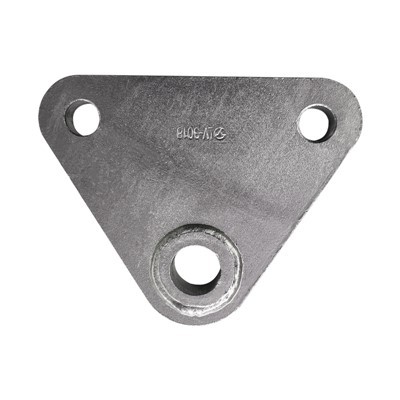


Double Cross Yoke Plates are primarily used in high-voltage and ultra-high-voltage power lines. The entire production process, from raw materials to finished product, involves multiple steps, each directly determining the strength, lifespan, and safety.
Double Cross Yoke Plates are primarily used in high-voltage and ultra-high-voltage power lines. The entire production process, from raw materials to finished product, involves multiple steps, each directly determining the strength, lifespan, and safety.
Raw Material Inspection: Material quality is fundamental to strength. We typically select low-alloy high-strength steel plates such as Q355B and Q355D, and conduct chemical composition testing, mechanical property testing, and checks on plate thickness, flatness, and appearance (no cracks, no delamination). Only steel plates that pass this inspection proceed to the blanking process.
Correction and Shaping: Ensure the flatness error of the plate surface is ≤ 1mm/m. Manual or mechanical grinding is performed to remove sharp burrs from the plate edges and hole openings. Chamfering is applied to critical stress holes to prevent scratches to installers and improve zinc coating adhesion.
Hot-dip galvanizing: This is a crucial process for rust prevention of Double Cross Yoke Plates. It ensures a uniform, smooth, and unblemished zinc layer with a thickness ≥85μm. After galvanizing, zinc nodules and burrs are removed, and the hole positions are checked for changes due to thermal expansion and contraction. Dimensions are ensured to conform to the drawings, and installation is smooth and unobstructed.
Finished product inspection: A full inspection is conducted, including appearance, dimensions, hole symmetry, hardness, material sampling, destructive tensile testing, and load testing. Only qualified products are shipped to the user.
Double Cross Yoke Plates are primarily used for suspending double insulator strings. Different specifications correspond to different voltage levels, conductor cross-sections, tower stress, and environmental conditions. Common specifications are as follows:
120-Grade Double Cross Yoke Plate:A very common model, rated breaking load 120kN, plate thickness 14mm or 16mm, side holes Φ20/Φ22, typical dimensions 300–400mm × 100–120mm × 14/16mm. Mainly used in 110kV transmission lines, 220kV light-load lines, and conventional lines with low wind, no icing, and no large spans.
160-Grade Double Cross Yoke Plate:Primarily used in high-voltage lines, offering high cost-effectiveness, rated breaking load 160kN, plate thickness 16mm or 18mm, side holes Φ22/Φ24, typical dimensions 360–450mm × 120–140mm × 16/18mm. Used in 220kV lines. Mainstream transmission lines and substation incoming and outgoing lines are double-string suspended;
200-grade Double Cross Yoke Plate: Primarily used in heavy-load lines, with a rated breaking load of 200kN. Plate thickness is 18mm or 20mm, with side holes of Φ26/Φ28. Typical dimensions are 420–520mm × 140–160mm × 18/20mm. Mainly used in 220kV heavy-load lines and 500kV light-to-medium-load lines, such as in areas with heavy icing, high winds, and high altitudes.
The Double Cross Yoke Plate has a very simple structure, high strength, and is hot-dip galvanized for corrosion protection. Its normal service life can reach 20-30 years. If used in harsh environments, proper maintenance and upkeep are necessary to avoid potential safety hazards in the circuit.
Routine Inspection
Regular lines should be inspected every 1-2 years; in heavy icing and high-wind areas, every 6-12 months. Check for overall deformation, bending, cracks, damaged or rusted zinc coating, loose bolts and nuts, and debris during handling.
Corrosion Protection
Although the connecting plates are hot-dip galvanized for corrosion protection, prolonged use may result in bumps, scratches, and corrosion. Minor corrosion can be touched up with paint; moderate rust requires rust removal; and severe rust necessitates replacement of the connecting plates to prevent breakage.
Cleaning and Maintenance
Wipe the surface with clean water or a neutral detergent to keep the plate clean and slow down corrosion. Remove debris from holes to prevent dirt and dust from getting trapped, which can lead to loose bolts and uneven stress. Regular cleaning ensures a tight connection.
Hot Tags: double cross yoke plate, China double cross yoke plate manufacturers, suppliers, factory