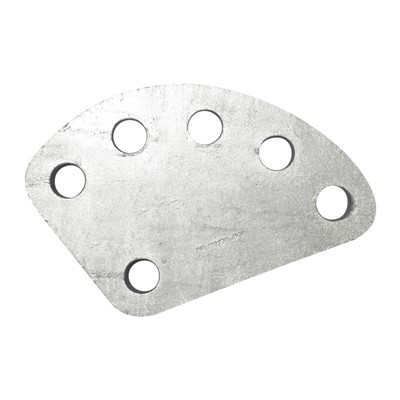


Model: PT-07240-375
Model: PT-10265-415
Model: PT-12330-510
Material: Hot-dip galvanized steel
Application: Suitable for 10kV-35kV distribution line projects
Model: PT-16370-580
Material: Hot-dip galvanized steel
Application: 35kV-110kV transmission lines
Model: PT-21370-580
Material: Hot-dip galvanized steel
Application: 110kV-220kV transmission lines
Model: PT-32420-660
Material: Hot-dip galvanized steel
Application: 330kV and above ultra-high voltage transmission lines
The PT Adjusting plate adjusts the connection length by adjusting the position of the middle bolt hole. The positions of the hanging holes on both sides remain unchanged. The string length is changed by adjusting the position of the middle bolt hole to meet different engineering needs. Compared with the DB type adjustment plate, its adjustment method is more suitable for scenarios that require fixed end connection and flexible adjustment of the middle position.
The PT Adjusting plate adjusts the connection length by adjusting the position of the middle bolt hole. The positions of the hanging holes on both sides remain unchanged. The string length is changed by adjusting the position of the middle bolt hole to meet different engineering needs. Compared with the DB type adjustment plate, its adjustment method is more suitable for scenarios that require fixed end connection and flexible adjustment of the middle position. During production, Q235 steel is selected, and the surface is hot-dip galvanized to ensure a corrosion resistance of more than 20 years. The main feature of the PT Adjusting plate is its convenience and flexibility. It can be adjusted immediately according to needs, effectively compensating for small errors in the construction process, reducing the overall adjustment work caused by errors, and saving time and manpower.
The adjustment accuracy of the PT Adjusting plate is affected by many factors, usually from structural design, processing and manufacturing, installation operation, external environment, etc. Let's analyze it below:
Hole Spacing Error
Whether the spacing design of the locking hole and the matching hole is reasonable directly affects the adjustment accuracy;
01
Through Slot Design
The width, flatness and roughness of the through slot will affect the smoothness of the end plate when sliding. Rough processing or deformation of the through slot may cause the end plate to jam and make it difficult to accurately position;
02
Material Accuracy
The cutting accuracy of steel, the verticality of the punching hole and the hole diameter tolerance will directly affect the tightness of the hole position;
03
Processing Error
The dimensional tolerance of the PT Adjusting plate and the relative position accuracy of the through slot and the hole position may result in the inability to adjust the length according to the design intention after assembly;
04
Load Influence
During the operation of the line, changes in the tension of the conductor, wind vibration, etc. may cause the adjustment plate bolts to loosen or the end plate to move slightly, and long-term accumulation will affect the adjustment accuracy.
05
Common models of PT Adjusting plate include PT-07240-375, PT-10265-415, PT-12330-510, PT-21370-580, and PT-324240-660. Different models have different accuracies in different environments. They are also affected by factors such as temperature, humidity, corrosive media, mechanical loads, and vibration frequency. You should understand them before use.
Temperature: thermal expansion and contraction have an impact on the structural dimensions. Changes in ambient temperature cause slight changes in dimensions, affecting the accuracy of the hole position;
Humidity: When the humidity is greater than 60% or in a salt spray environment, the steel is prone to electrochemical corrosion, and rust is generated on the surface, which increases the surface roughness of the through slot and the hole position, and the sliding resistance can increase by 2-5 times;
Corrosion: It causes the bolts to lock with the hole wall, and forced knocking is required during adjustment, further damaging the hole position accuracy;
Load: Overload causes permanent bending and deformation of the through slot, and the adjustment accuracy loss can reach 5%-10%;
Vibration: High-frequency vibration causes the bolts to loosen, the end plate to move, and the adjustment accuracy decreases by 2-5mm each year.
When using PT Adjusting plate, materials must be selected and installation procedures optimized according to environmental conditions. Regular maintenance should also be performed to mitigate adverse environmental impacts and ensure the safety and reliability of power lines.
High-altitude areas
The main steel material should be Q345E low-temperature steel to prevent low-temperature brittle fracture.
01
Chemically corrosive areas
The main body should be constructed of Q345B steel with a nano-ceramic coating, capable of withstanding salt spray tests for ≥1500 hours.
02
Heavy icing areas
Note that the main body thickness should be increased by 10%, and a super-hydrophobic coating should be applied to the surface to reduce manual de-icing.
03
High-temperature and high-humidity areas
The galvanizing thickness should be increased to 100μm, and an anti-mold varnish should be applied to inhibit mold growth.
04
Hot Tags: pt adjusting plate, China pt adjusting plate manufacturers, suppliers, factory, adjusting plate, DB 0770 170 type Adjusting plate, DB 12100 240 Adjusting Plate, DB 12100 240 type Adjusting plate, DB 21120 180 Adjusting Plate, PT type Adjusting plate