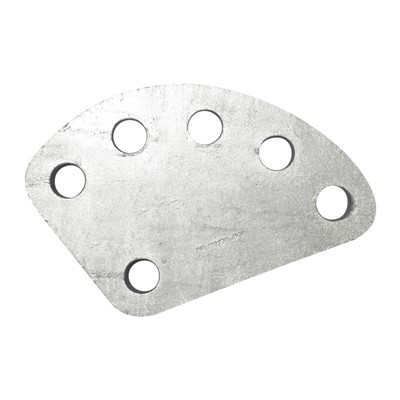

In high-voltage transmission lines, it is connected in series between the connecting hardware and tension clamps of the tension insulator strings of split conductors. By changing the fixing position of the bolts in different holes on the regulating plate, construction personnel can precisely adjust the slack of the two split conductors, ensuring line tension balance.
As indicated by its model name, this type of regulating plate typically has a flexible adjustment range (such as an adjustment span of 170mm to 180mm). As a connecting fitting, it needs to withstand extremely high mechanical tension; therefore, it is manufactured using high-strength hot-dip galvanized steel to ensure corrosion resistance and structural stability in harsh outdoor environments.
Unlike ordinary small regulating plates with limited load-bearing capacity and a small adjustment range, this DB model regulating plate is specifically designed for heavy-duty load-bearing scenarios. The product is made of thickened Q235 steel through integral stamping, resulting in a uniform and solid plate with no welded joints, structurally eliminating the risk of breakage under stress. The multi-row precision adjustment hole design provides ample adjustment space on-site, directly adapting to most installation errors without the need for secondary on-site processing or cutting. The overall dimensions strictly conform to national standards, with precise hole positions and small tolerances, ensuring high compatibility with various conventional power fittings, smooth installation, and strong engineering versatility.
In practical engineering applications, the DB-21120-180 adjustment plate demonstrates outstanding practicality. It is primarily used for fine-tuning the tension of high-voltage tower guy wires, correcting the distance of overhead ground wire hanging points, and adjusting the assembly gap of tension insulator strings. It is also suitable for auxiliary fixing and adjustment of substation structural equipment. The overall structure is simple and flexible to install, requiring no complex tools or cumbersome procedures, resulting in significantly higher construction efficiency than traditional adjustment methods. Furthermore, it boasts high overall rigidity, excellent wind pressure resistance, and excellent tensile strength, maintaining structural stability even under long-term dynamic stress at high altitudes, greatly reducing the frequency of subsequent line maintenance and parts replacement.
Incoming Inspection; In addition to verifying the factory quality certificate, a random inspection of the appearance should be conducted, focusing on whether there are burrs on the inner wall of the regulating hole, whether the zinc layer is intact, and whether the plate body is bent or deformed. Products with excessive hole spacing or micro-cracks are strictly prohibited.
Installation Operation;During installation, ensure that the bolt axis coincides with the center of the regulating hole. Forced installation that could subject the hole wall to shear force is strictly prohibited. After tightening, a matching stainless steel closing pin must be installed, and the tail end must be fully split to prevent loosening due to vibration
Operation and Maintenance Strategy;During routine inspections, attention should be paid to whether the regulating plate exhibits plastic deformation, abnormal wear, or severe corrosion. Especially during high-load operation, check for signs of overheating and discoloration at the connection points. If any defects are found, power should be immediately cut off and replacement arranged
The DB-21120-180 regulating plate, with its simple structure, high reliability, and convenient adjustment, plays an irreplaceable role in high-voltage transmission projects. Although the technical principles are not complex, the precision of its processing and the quality of its installation directly affect the operational safety of the entire line. It is recommended that technical parameters be strictly defined during the engineering design and material procurement phases, and that process control be strengthened during construction to ensure the inherent safety of power grid equipment.
Hot Tags: db-21120-180 adjusting plate, China db-21120-180 adjusting plate manufacturers, suppliers, factory, DB 12100 240 type Adjusting plate, DB 0770 170 Adjusting Plate, DB 1080 200 Adjusting Plate, PT type Adjusting plate, DB 12100 240 Adjusting Plate, DB type Adjusting plate