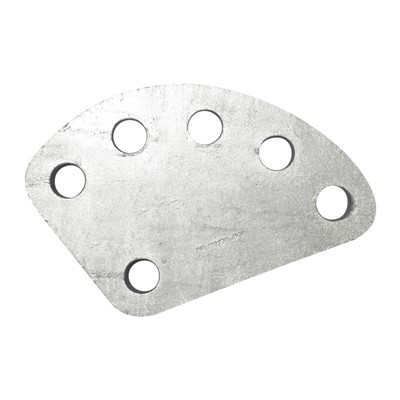


Specifications
|
Parameter |
Specification |
|
Product Name |
PT Adjuster Plates |
|
Structure |
Adjusting Screw, Connection Holes, Fixing Bolts |
|
Length Adjustment Range |
±30 mm ~ ±100 mm |
|
Common Models |
PT-7 / PT-10 / PT-12 |
|
Material Options |
Q235B Carbon Steel / Q355B High Strength Steel / 304 Stainless Steel |
|
Surface Treatment |
Hot Dip Galvanized |
Core Advantages of the Product:
1. Precise Length Adjustment: Adjustable screws allow for fine-tuning within a range of ±30~±100mm, compensating for dimensional deviations during installation and ensuring uniform stress on the insulator string without tilting.
2. Simple Structure and Easy Installation: The PT Adjuster Plates feature a simple overall structure, requiring no complex tools for installation and commissioning, resulting in high on-site construction efficiency.
3. Multiple Material Options: Available in carbon steel, high-strength steel, and stainless steel to suit different load and corrosive environments.
4. Stable and Reliable Connection: Bolted connections ensure a secure lock after adjustment, preventing loosening or displacement during operation.
5. Wide Applicability: PT Adjuster Plates are suitable for various voltage levels, from low-voltage lines to 500kV ultra-high-voltage projects.
Material Selection Reference
| Material | Yield Strength | Corrosion Resistance | Cost | Application |
| Carbon Steel (Q235B) | ~235 MPa | Fair, anti-corrosion treatment required | Low | Light load (≤50kN) secondary components, dry environments, budget-limited projects |
| High Strength Steel (Q355B) | ~355 MPa | Fair, anti-corrosion treatment required | Medium | Heavy load (>50kN) load-bearing components, balance of cost and performance |
| Stainless Steel (304) | Similar to carbon steel | Excellent, no additional treatment needed | High | Humid, coastal, corrosive environments, maintenance-free operation |
Application Scenarios
•High-voltage transmission lines: Adjusting the length of double-string insulators to balance the stress on insulators on both sides of the angle tower and compensate for construction distance deviations.
•Tower connections: Connecting tower crossarms to insulators and grounding hardware; adapting to different structural dimensions and suspension points through hole position adjustment.
•Urban and rural power grid construction: Adapting to diverse line routes and connection angles in complex erection environments to ensure stable connections.
•Special environmental engineering: Corrosive environments such as coastal areas, industrial zones, and high-humidity mountainous areas; hot-dip galvanizing treatment reduces salt spray and exhaust gas corrosion, reducing subsequent maintenance.
Installation Precautions
1. Visual inspection before installation: Surface free of rust, deformation... 1. Check for cracks, smooth threads, and intact galvanized layer. Verify the model, load, and adjustment range.
2. Before installation, wipe away surface dust and oil. A small amount of rust inhibitor can be applied.
3. Tighten bolts evenly to the specified torque, avoiding excessive force on one side to prevent damage to the threads.
4. After adjustment, confirm that the position is not offset and the connection is secure and not loose.
5. Avoid violently striking the product to prevent affecting the adjustment accuracy; avoid outdoor installation in rainy or foggy weather.
For precise dimension drawings, detailed quotations, or customization requirements for specific models, please provide circuit parameters, operating conditions, or design drawings. We will match suitable specifications for you and provide FOB/CIF quotations, minimum order quantities, packaging, and shipping details.
Hot Tags: pt adjuster plates, China pt adjuster plates manufacturers, suppliers, factory, DB 12100 240 type Adjusting plate, DB 0770 170 Adjusting Plate, DB 1080 200 Adjusting Plate, PT type Adjusting plate, DB 12100 240 Adjusting Plate, DB type Adjusting plate