

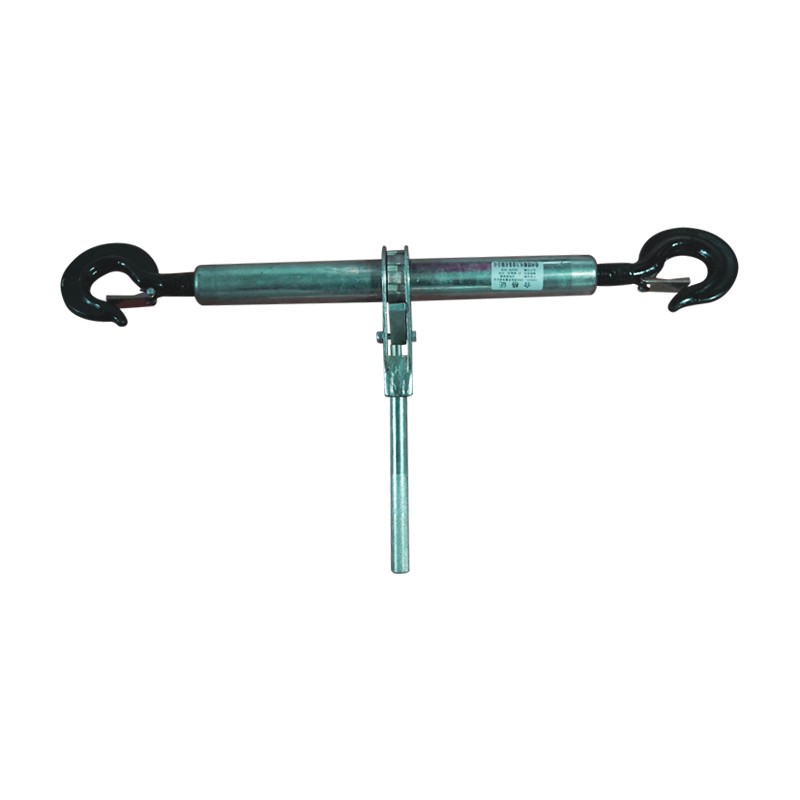


Structural Composition: This tool mainly consists of a hook-shaped lead screw, nut, sleeve, safety pin, ratchet, pawl, handle assembly, and locking plate. Its hook is typically forged with a thickened, embedded clamp and features 360-degree rotation to prevent the wire rope from twisting under load.
Double Hook Wire Tightener General Basic Parameters (Unified Standard for the Entire Series)
Main Material: Q235 High-Quality Carbon Steel, Stamped and Forged
Surface Treatment: Overall Hot-Dip Galvanized, Corrosion and Rust Prevention
Thread Type: Coarse-pitch Trapezoidal Thread, Self-Locking and Non-Rebounding
Hook Structure: One-piece Thickened Hook, Arc-shaped Opening to Prevent Rope Detachment
Execution Standard: General Tensile Testing Standard for Power Construction Tools
Usage Environment: Suitable for outdoor use, coastal areas, and humid construction sites at -30℃ to 60℃
Testing Requirements: Each unit undergoes a static load tensile test at the factory; no deformation or cracking occurs at 1.5 times the rated tensile force.
Selection Reference
Small Fences, Simple Bundling, Low-Voltage Wiring: 1t, 2t Models
Power Line Steel Strand Tightening, Formwork Reinforcement: 3t Model
High-Voltage Cables, Steel Structure Tightening, Heavy-Duty Bundling: 5t Model The entire tool set features a uniform hot-dip galvanized surface treatment for rust prevention, making it resistant to rust even during long-term outdoor storage and outdoor construction. Construction site environments are complex, with constant exposure to sun, rain, dust, and gravel. Poor rust prevention can cause the screw rod to rust and seize up quickly, making it impossible to tighten next time. The thick zinc coating isolates it from moisture and salt corrosion, ensuring normal adjustment even in coastal or humid mountainous areas, eliminating the need for frequent lubrication and reducing tool wear and tear.
Its applications are actually quite broad, not just limited to the power industry. It's suitable for tightening steel strands for overhead cables, securing steel wires during fencing construction, temporarily reinforcing formwork, and securing cargo with steel ropes. The hook opening size has been optimized, allowing most common steel wire ropes, steel strands, and metal lugs to easily engage without easily slipping off. No need to adjust the hook angle during operation; it's simple to use, and even beginners can master it after a quick demonstration.
A comprehensive selection of specifications is available, ranging from light-duty models with low tensile strength to heavy-duty models with high load capacity. Light-duty models are suitable for simple binding on small construction sites, while heavy-duty models are ideal for tightening high-voltage cables and large steel structures. All products undergo tensile testing before leaving the factory, and their load-bearing capacity parameters meet industry standards. They are suitable for domestic engineering projects and overseas export projects, exhibiting minimal quality fluctuations. Even with large-volume orders, there's no need to worry about inconsistent performance between batches.
Overall, the double-hook wire fastener is a highly practical and simple tightening tool. Its simple structure effectively solves numerous on-site tightening and securing problems. The symmetrical force distribution of the double hooks enhances safety, the thickened steel ensures load-bearing capacity, and the galvanizing process extends its service life. Furthermore, its easy adjustment and operation, adaptability to various scenarios, and long-term cost-effectiveness make it a highly cost-effective choice. If your projects frequently require on-site tightening of steel wire, steel strand, and various metal ropes, and you desire a durable, easily operable, and durable fastening tool, this double-hook wire fastener is a reliable option.
Hot Tags: double hook wire tightener, China double hook wire tightener manufacturers, suppliers, factory, power construction tools, Insulated Nylon Sheave Hoisting Tackle, 40 20Y Vibration Damper, Double Hook Wire Tightener, Dual purpose Nylon Pulley, Vibration Damper


