
There is no unified international standard for the specifications of galvanized triangular yoke plates. The specifications are mainly determined based on factors such as application scenarios, load-bearing requirements, and the dimensions of connecting components. The core specifications revolve around four main categories: structural dimensions, material, galvanizing standard, and load-bearing capacity. Below are common industry specification classifications and key parameters:
Plate thickness: Common range 4mm~20mm, adjusted according to bearing pressure, common thicknesses are 4mm, 5mm, 6mm, 8mm, 10mm, 12mm, 14mm, 16mm, 18mm, 20mm;
Side length of a triangle: refers to the distance between the centers of the three vertices of a triangle. Common specifications are 80mm×80mm×80mm, 100mm×100mm×120mm; 120mm×120mm×150mm, 150mm×150mm×180mm, 200mm×200mm×250mm; 250mm×250mm×300mm, 300mm×300mm×350mm, and 400mm×400mm×500mm;
Hole diameter: Used for threading bolts/pins to match the bolt specifications of the connected components. Common sizes are M8, M10, M12, M14, M16, M18, and M20. Hole center distance: The distance between the centers of two adjacent holes. It must match the mounting hole position of the connected components. Common sizes are 50mm, 60mm, 80mm, and 100mm.
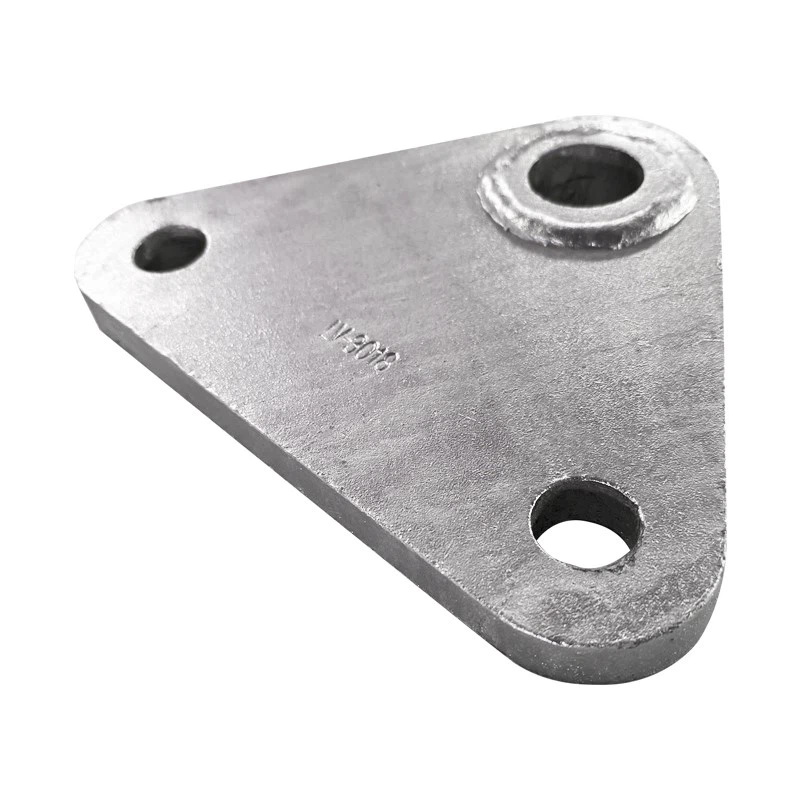
Material specifications are determined by the required performance of the galvanized triangular yoke plate:
Ordinary carbon steel: Q235, suitable for light to medium loads and environments without special corrosion, with lower cost;
High-strength carbon steel: Q345, suitable for heavy loads and high load-bearing applications, with strength more than 30% higher than Q235;
Stainless steel: 304/316 stainless steel, further galvanized (or passivated), suitable for coastal and chemically corrosive environments, but with higher cost.
The galvanizing standard directly affects corrosion resistance and service life. Hot-dip galvanizing: Complies with GB/T 13912-2022 and ASTM A123, with a zinc layer thickness ≥65μm (normal applications) and ≥85μm (corrosive environments), ensuring a uniform surface without any missed areas or bulges. Electro-galvanizing: A zinc layer thickness of 10~20μm, suitable for indoor and dry environments, with a lower cost than hot-dip galvanizing, but weaker corrosion resistance.
Load Capacity Specifications:
Light Duty: Rated load ≤ 5kN;
Medium Duty: 5kN~20kN;
Heavy Duty: 20kN~50kN;
Extra Heavy Duty: ≥ 50kN;
In many scenarios, galvanized triangular yoke plates are customized according to customer needs. When customizing, parameters such as load-bearing requirements, dimensions of connecting parts, and usage environment must be provided to ensure that they can match the working conditions.
The power sector demands extremely high requirements for the load-bearing stability and weather resistance of components. Galvanized triangular yoke plates, as core components of "connecting hardware," are suitable for the force transmission requirements of high-voltage/low-voltage lines.
Application Scenarios: Connecting insulator strings, conductors, tower crossarms, or fixing shunt conductors and jumpers;
Core Requirements: Bearing the conductor's own weight, wind load, and snow and ice load; resistant to rain and UV corrosion in outdoor environments;
Typical Usage: Connecting insulator strings (2 holes) and tower crossarms (1 hole) through three holes in the yoke plate, evenly distributing conductor tension and preventing uneven stress and breakage of the insulators; used for split conductors (2~4 splits) in 220kV and above high-voltage lines as branch connection points to distribute conductor tension.
Suitable Specifications: Medium/Heavy-duty (plate thickness 8~14mm, hole diameter M16~M20, load capacity 10~30kN), hot-dip galvanized (compliant with GB/T 13912-2022).