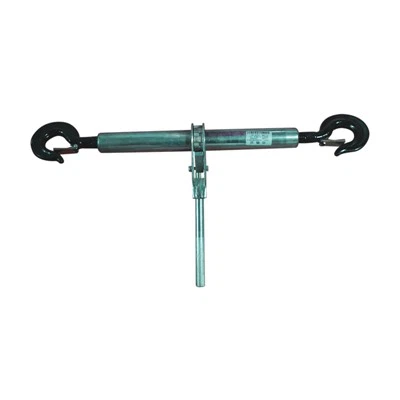
Many people new to electrical fittings only pay attention to accessories like ball joint rings and U-shaped rings that directly connect to insulators, often overlooking the seemingly insignificant extension rings. However, in actual construction and long-term operation and maintenance, this elliptical parallel ring is a key component for solving installation problems. Without it, many pole and tower stringing operations would be difficult to successfully complete. It is uniformly named the PH type extension ring. Both ends are complete circular rings, forged as a single piece. While its structure appears simple, it performs multiple functions, including adjusting spacing, changing connection angles, and buffering line tension. It is suitable for use in all scenarios from 10kV distribution to ultra-high voltage transmission lines.
The mainstream specifications on the market are PH-7, PH-10, PH-12, and PH-16, etc. The last number of the model number corresponds to the rated breaking load in kilonewtons. When selecting a model, it is essential to match the tonnage of the ball joint rings and U-shaped rings in the same string. A smaller specification cannot be arbitrarily substituted for a larger load model. Under long-term icing and strong wind conditions, mismatch can easily lead to ring cracking and tensile deformation. Made from high-quality carbon steel through a single forging process, unlike simple welded models, the integrally formed ring body has no weak weld points, resulting in better fatigue resistance. Even with years of wind-driven, reciprocating conductor swinging, it is less prone to metal fatigue cracks. This is the core reason why integrally forged models are preferred in engineering procurement.
The surface undergoes a uniform hot-dip galvanizing anti-corrosion treatment, resulting in a thick and even coating. Whether in dry inland mountainous areas or coastal regions with heavy salt spray and chemical pollution, this coating significantly slows down the rate of steel corrosion. If the galvanized layer wears off, the ring body will rapidly oxidize and thin, drastically reducing its load-bearing capacity. During subsequent inspections, special attention should be paid to inspecting the ring body and curved corners for rust spots and cracks, and timely replacement should be made to avoid the risk of line breakage and tripping. In standard assembly processes, extension rings are often connected in series between the U-shaped hanging ring and the ball-head hanging ring to form a complete hanging string: Crossarm U-shaped hanging ring → PH extension ring → Right-angle hanging plate → QP ball-head hanging ring → Insulator. The entire assembly connects smoothly, and the ring can rotate freely 360 degrees without causing hardware jamming or conductor twisting due to stress.
Two common installation problems encountered during on-site construction can be easily solved with extension rings. The first is insufficient space between the tower crossarm and the insulator, which can easily cause the jumper wire to touch the tower components during swinging, creating a risk of wind-induced discharge. Adding an extension ring of appropriate length can lengthen the overall connection distance, meeting the electrical safety clearance requirements. The second is isolated conductor tightening operations, where excessive tension can easily occur after the conductor is tightened, directly damaging the insulator and clamp. Inserting an extension ring can absorb excess tension, distribute the stress, and reduce the probability of overload damage to hardware and conductors. Many 500kV high-voltage line renovation projects involve the mass installation of extension rings to optimize the stress structure.
There are many easily overlooked details during use, and even slight negligence by construction workers can create safety hazards. After all the interlocking pins are installed, they must be properly secured with cotter pins to prevent pin detachment or hardware slippage due to strong winds and vibrations. Hardware of different materials and load ratings must not be mixed; the load-bearing capacity of the entire string is determined by the weakest component. During storage, avoid outdoor stacking and exposure to rain to prevent rusting. During handling, minimize bumps and scratches that could damage the galvanized layer, as damage to the coating will significantly shorten its outdoor lifespan.
Comparing ball-head rings and extension rings, their functions are clearly defined and they are not interchangeable. The ball-head ring has a ball-shaped plug at one end specifically for connecting to the insulator socket; it is a dedicated insulator connector. Extension rings have round ends and serve only as general-purpose transition components, responsible only for increasing the spacing and adjusting the connection direction; they do not directly contact the insulator body. The entire set of line hardware must be used in combination, each performing its specific function, to ensure long-term stable operation.
From rural power distribution branches to urban high-voltage towers and large substation structures, extension rings have stable applications wherever insulator strings, lightning arresters, and conductor clamps are involved in connection and adjustment. Despite their simple structure, they solve numerous practical problems related to on-site installation and stress balance, making them a typical example of small components carrying significant safety. Engineering procurement doesn't need to excessively pursue complex designs; standard PH extension rings that meet national standards for integral forging, hot-dip galvanizing, and load parameter matching can meet the long-term operation and maintenance needs of most lines, reducing the frequency of later maintenance and replacement, and minimizing the cost losses caused by line downtime for maintenance.