


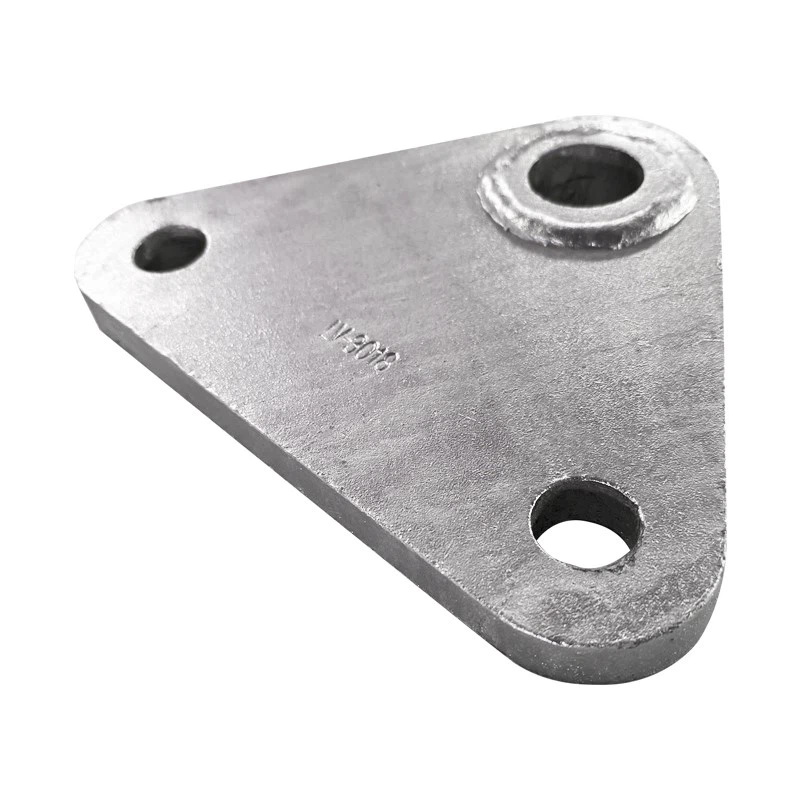
Specification Parameters
|
Parameter |
Details |
|
Product Name |
Galvanized Triangular Yoke Plate (L Type) |
|
Model Series |
L-07 / L-10 / L-12 / L-16 / L-21 / L-25 / L-32 / L-42 |
|
Base Material |
Q235 Carbon Structural Steel |
|
Forming Process |
One-piece stamping, no welded joints |
|
Surface Treatment |
Hot-dip galvanized, compliant with ISO 1461 |
|
Rated Breaking Load |
70kN ~ 750kN |
|
Suitable Conductor Cross-section |
400mm² ~ 600mm² |
|
Hole Diameter Tolerance |
H13 |
|
Hole Center Distance Deviation |
≤0.2mm |
|
Suitable Voltage Level |
10kV ~ 500kV overhead transmission lines |
|
Packing |
Plywood case / wooden pallet, reinforced with steel belt |
Key advantages in practical applications:
1. The triangular three-point structure evenly distributes lateral and longitudinal loads, significantly improving resistance to eccentric loads and torsional forces compared to ordinary straight-line connection plates. At corners, in mountainous areas with significant elevation differences, and in regions with frequent strong winds, straight-line connection plates are prone to stress concentration on one side, leading to deformation. The triangular structure effectively avoids this problem and provides a greater safety margin under short-term overload conditions such as freezing or strong winds.
2. The entire sheet is formed by one-piece stamping, eliminating the need for splicing and welding. Tension members are subjected to alternating tensile forces year-round, and welds are the most prone to cracking. One-piece molding eliminates this potential risk from the outset, ensuring safer long-term operation.
3. Hole diameters are machined according to industry standards, with a hole diameter tolerance of H13 grade and a center distance deviation controlled within 0.2mm. Standard bolts and pins can be directly inserted without on-site grinding or hole enlargement. In high-altitude operations, every second counts; precise dimensions save significant time and effort.
4. This galvanized triangular yoke plate features a uniform hot-dip galvanized surface, strictly conforming to ISO 1461 standards. It can withstand normal outdoor humidity, industrial dust, and coastal salt spray. For projects located in highly corrosive chemical industrial areas or coastal regions, the galvanized layer thickness can be increased as needed, and corresponding salt spray test reports will be provided.
Main Applications:
· Tension section connections for 10kV~500kV overhead line terminal towers and corner towers
· Long-span, high-wind transmission lines in mountainous areas
· Substation incoming and outgoing line fittings
· Line maintenance and repair, replacement of old fittings
Production and Quality Control:
· This galvanized triangular yoke plate uses Q235 carbon structural steel as raw material. Each batch of products is accompanied by a steel mill material certificate; substandard materials are never used in the production process.
· Mature production process: Materials are cut to specifications, CNC punched, chamfered, deburred, and then hot-dip galvanized as a whole. The entire production process has no welding steps, and the one-piece molding process is stable and reliable.
• We have a rigorous quality control system: The first piece is tested before mass production to ensure dimensional accuracy. During production, random sampling of hole positions and sheet thickness is conducted across batches. Each finished product undergoes visual inspection, and defects such as incomplete plating, zinc lumps, and burrs are removed. Samples from each batch are randomly selected for tensile strength and zinc plating thickness testing, and corresponding test reports are provided with each product.
• SGS and BV certifications are required. Third-party inspections by these organizations are also accepted; please schedule in advance.
Customization and Services:
• For non-standard sizes, special hole positions, or sheet thickness requirements, please provide drawings, and we will arrange sample production. We also accept small trial orders; large quantities are not mandatory.
• We have readily available molds for standard models, ensuring stable delivery times and short replenishment waiting times.
• Material certificates, zinc plating test reports, and all necessary customs clearance documents will be prepared in advance and sent to you along with the goods to ensure timely customs clearance.
• Packaging fully complies with sea freight standards. Moisture-proof paper is used between products to prevent zinc leaching due to friction. The outer packaging is a fumigation-free wooden crate/pallet reinforced with steel straps, and cushioning pads at the corners to minimize damage during transportation.
If you are unsure how to select a model, please provide parameters such as line voltage, conductor cross-sectional area, and rated tension. We will help you find the most suitable model and provide a clear price and delivery time.
Hot Tags: galvanized triangular yoke plate, China galvanized triangular yoke plate manufacturers, suppliers, factory, LS 1212 Yoke Plate, L 1240 type yoke plate, LF 3040 Yoke Plate, LS type yoke plate, LF 2140 Yoke Plate, LV 1020 Yoke Plate


