
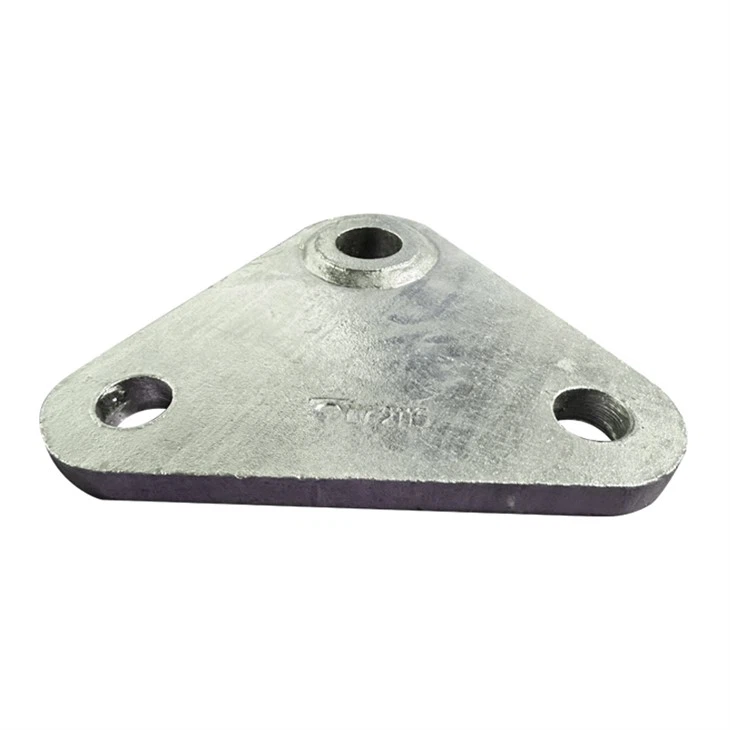
The Strain Triangle Yoke Plate is a core hardware component in high-voltage transmission and distribution lines. Its triangular, three-hole layout allows for the articulation of insulator strings, conductor clamps, and tower crossarms. It addresses tension transmission, load distribution, and angle adjustment, making it suitable for tension applications such as terminals, corners, and long spans. It is widely used in global power grids and renewable energy projects, resulting in substantial sales volume.
The Strain Triangle Yoke Plate is a tension hub that connects tension clamps, insulator strings, and tower crossarms, evenly distributing conductor tension to the tower. It also ensures fixed spacing and angle adaptation for multi-split conductors, preventing concentrated stress at single points. Its triangular three-hole layout-one hole connecting to the tower side and two holes connecting to the conductor side-forms a stable stress triangle, dispersing dynamic loads and strong wind impacts, thus improving structural safety. It achieves standardized installation, high corrosion resistance, and low maintenance, meeting the tension and insulation coordination requirements of high-voltage/ultra-high-voltage projects. Installation efficiency is improved by approximately 40%, and its lifespan reaches 15-20 years.
When purchasing Strain Triangle Yoke Plates, users pay close attention to performance characteristics, as different performance characteristics affect the price. As a professional manufacturer, we continuously improve performance while maintaining a low price, mainly in the following aspects: All-scenario corrosion protection: Hot-dip galvanizing + metallurgical combination, salt spray environment life of 15-20 years, 5-8 times that of electro-galvanized plates, suitable for coastal, high humidity, and high salt spray areas.
High tensile strength and stability: Cold-worked one-piece molding, no welding stress, triangular layout to distribute tension, rated tensile strength of 40-80 kN, strong wind and dynamic load resistance.
Standardized compatibility: Precise hole positioning, directly matches American standard/European standard/Chinese standard bolts and fittings, eliminating the need for on-site secondary processing and improving construction efficiency.
If you are unsure whether Strain Triangle Yoke Plates can be applied in a real-world scenario, you can refer to the following scenarios:
High Voltage/UHV Transmission: For terminal towers, angle towers, and long-span sections, connecting tension clamps and double-string insulators, Q345B with hot-dip galvanized steel (≥85 μm) is recommended. The plate thickness is 8 mm, the hole diameter is 18 mm, and the triangular hole positions disperse tension.
New Energy Engineering: For photovoltaic support purlin-column hinged connections and wind turbine tower auxiliary connections, Q235B with hot-dip galvanized steel is recommended. The plate thickness is 6 mm, the lightweight design (single weight ≤1 kg) is suitable for construction in remote areas.
Telecommunications Engineering: For communication tower member hinged connections and base station bracket fixing, Q235B with hot-dip galvanized steel is recommended. The plate thickness is 4–6 mm, the hole diameter is 14–16 mm, and installation is convenient.
Transportation and Municipal Engineering: For highway guardrail splicing and signpost base hinged connections, Q235B with a thickened zinc layer (≥100 μm) is recommended. The plate thickness is 8–10 mm, impact resistant, and suitable for high traffic volume and salt spray environments.
With its standardized design, hot-dip galvanized corrosion resistance, high-strength structure, and global adaptability, the Strain Triangle Yoke Plate has become a key component for power grid upgrades and new energy construction. For export sales, we emphasize a "standard + customized dual-track approach, full certification, and long warranty," precisely matching the engineering and compliance needs of customers in North America, the Middle East, and Southeast Asia, facilitating efficient procurement and project implementation.