
Strain Triangle Yoke Plates are primarily used in overhead transmission lines, mainly serving to collect, distribute, and transmit the tension between multiple insulator strings and conductors. In actual operation, the yoke plate withstands continuous conductor tension, wind-induced vibration, icing loads, temperature stress, lightning strikes, and multiple forms of corrosion from the atmosphere, salt spray, and industrial pollution. Its structural strength, mechanical stability, and corrosion resistance directly determine the safe operation level of the entire transmission line. The foundation and prerequisite for these properties lies in the scientific selection of materials during the manufacturing stage.
Material selection is not simply about choosing a particular type of steel, but a systematic decision based on a comprehensive consideration of multiple factors, including voltage rating, design tension, operating environment, processing technology, corrosion protection requirements, cost control, and domestic and international standards and specifications. The chemical composition, mechanical properties, weldability, cold working properties, hot-dip galvanizing adaptability, corrosion resistance, and fatigue properties of the material all directly affect the finished product quality, service life, and safety margin of the Strain Triangle Yoke Plate.
When selecting materials for Strain Triangle Yoke Plate, the core performance indicators that must be met are mainly considered from the following aspects:
Sufficiently high strength: including yield strength and tensile strength, ensuring no plastic deformation or fracture under maximum design load;
Good plasticity and toughness: preventing brittle fracture under low temperature, impact, and vibration;
Excellent fatigue resistance: resisting long-term wind vibration and alternating loads, avoiding fatigue crack propagation failure;
Excellent processability: including adaptability to cutting, punching, bending, welding, straightening, hot-dip galvanizing, etc.;
Corrosion resistance: meeting hot-dip galvanizing requirements, with a uniform zinc layer, strong adhesion, and no incomplete galvanizing, brittleness, or pitting;
Stable chemical composition: harmful elements such as carbon, sulfur, and phosphorus are controlled within standard ranges to ensure welding and galvanizing quality.
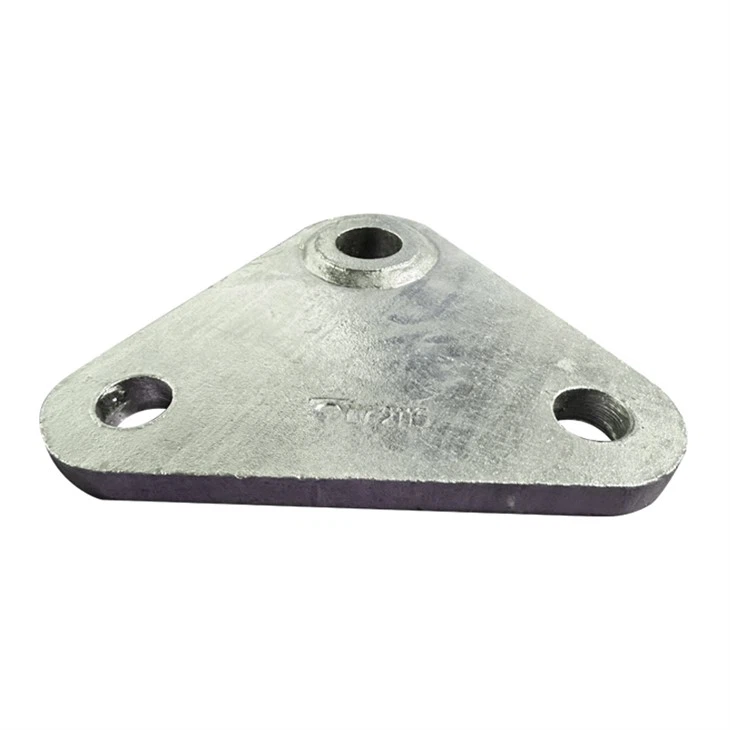
Based on long-term practice in the manufacture of transmission line fittings, the materials of Strain Triangle Yoke Plate are mainly divided into four categories: carbon structural steel, low alloy high-strength structural steel, weather-resistant structural steel, and high-strength alloy structural steel.
Carbon structural steel is currently the most commonly used and fundamental material for strain triangle yoke plates in medium and low voltage transmission lines both domestically and internationally. It boasts advantages such as low cost, good machinability, stable welding, and strong adaptability to galvanizing. The carbon content is moderate, generally ≤0.20%, ensuring plasticity, toughness, and weldability. Harmful impurities such as sulfur and phosphorus are strictly controlled to guarantee material purity. It contains no precious alloying elements, offering extremely high cost-effectiveness. Tensile strength is 370–500 MPa, yield strength is 235 MPa and 345 MPa, elongation after fracture is ≥21%, and impact energy meets the requirements for room temperature impact.
Low-alloy high-strength structural steel: Based on low-carbon steel, the addition of small amounts of alloying elements (Mn, Si, Nb, V, Ti, etc.) significantly improves strength while maintaining good plasticity, toughness, and processability. Low carbon content ensures weldability and toughness; the addition of trace alloying elements refines the grain, improving strength and low-temperature toughness; stricter sulfur and phosphorus control enhances fatigue and fracture resistance, making it suitable for high-strength, lightweight structural designs. Yield strength 355MPa–460MPa, tensile strength 470MPa–650MPa, and excellent low-temperature impact toughness, suitable for use in environments ranging from -20℃ to -40℃.
Weathering structural steel: By adding elements such as Cu, P, Cr, and Ni, a dense and stable protective rust layer is formed in the atmosphere, significantly reducing the corrosion rate. It is particularly suitable for harsh environments such as coastal salt spray, industrial pollution, high humidity, and acid rain. Containing corrosion-resistant elements such as copper, chromium, nickel, and phosphorus, a stable passivation film can quickly form on the surface, preventing corrosion from extending inward. Its low carbon content ensures compatibility with welding and galvanizing. It is mainly suitable for coastal areas, islands, salt spray regions, chemical industrial areas, industrial areas, and sulfide-polluted areas.
High-strength alloy structural steel: If the Strain Triangle Yoke Plate is used in extra-long span or super-heavy load lines, high-strength alloy structural steel must be selected. It contains alloying elements such as Cr, Mo, and Mn, has extremely high comprehensive mechanical properties, good hardenability, and top-level strength, toughness, and fatigue performance.